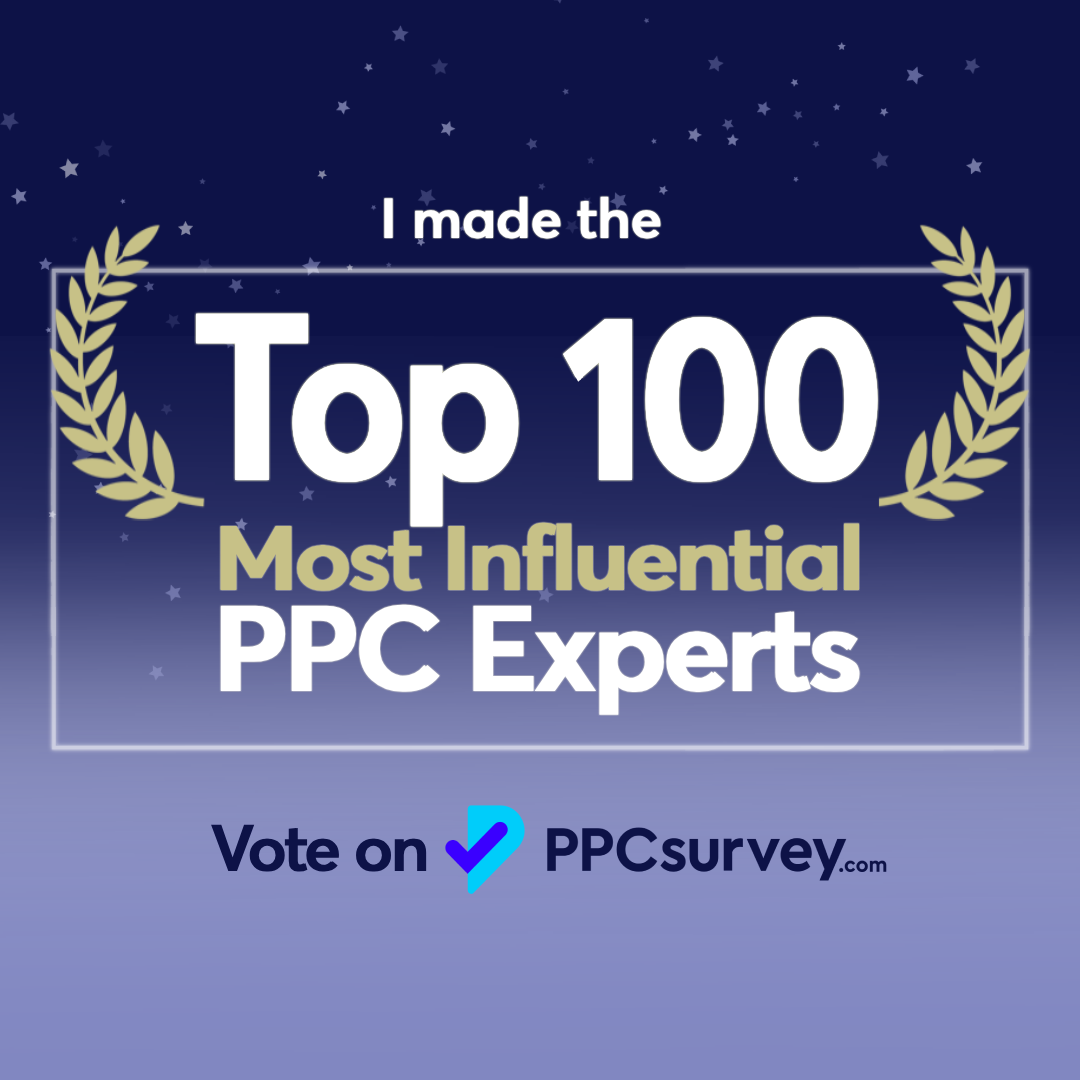
I got nominated for the Top 100 Most Influential PPC Experts this year, if I have helped you this year could you please vote for me using the link below? (thank you in advance 😀)
It takes about 3-5 minutes to complete the survey.
👉 Complete The Survey

Your Google Ads account structure is more important than any single optimisation you make inside the platform.
Too often, advertisers stress over:
-
Negative keywords
-
Match types
-
Ad copy tweaks
-
Bidding strategies
And while all of these are essential, none of them matter as much as one thing:
Your account structure is King (or Queen).
A strong structure determines:
-
How well Google’s automation works
-
How profitable your ad spend becomes
-
How effective your smart bidding is
-
How your campaigns scale
-
How well Google understands your goals
And most importantly, your structure will always bring you back to the core question that every advertiser must answer:
“Why are you actually running Google Ads?”
This week I take you step-by-step through how to plan and structure your Google Ads account correctly for 2026.
This is part of my 15-part Get Google Ready for 2026 series, helping you start, scale, and optimise your business with Google Ads.
Step 1: Answer the Most Important Question First
QUESTION 1: “Why do you want to run Google Ads?”
It sounds simple, but most advertisers never define this clearly.
Your answer fundamentally determines:
-
Which campaign types you should choose
-
What metrics matter most
-
Whether you prioritise volume or profitability
-
How you measure success
If you're a local business → Your goal might be:
-
More phone calls
-
More form submissions
-
More bookings
This leads to a structure prioritising:
Search campaigns → Call-focused setup → Strong CTAs → Offline conversion tracking
If you're an eCommerce brand → Your goal must go deeper:
Do you want:
1️⃣ More sales volume, even at a lower ROAS?
2️⃣ Higher profitability, even with fewer sales?
Your answer impacts:
-
Your tROAS targets
-
Your campaign segmentation
Growth goals = broader targeting + lower ROAS targets
Profit goals = tighter control + higher ROAS targets
This single question shapes your entire account.
Step 2: Identify the “Levers” You Need to Control
With AI playing a bigger role in Google Ads, your structure must give you control over:
Where Google spends money... and where it DOES NOT.
These are your levers:
1. Keyword / Service / Product Performance
Do certain products sell better?
Do some services convert at higher rates?
Do certain categories require budget caps?
2. Seasonality
Do you have seasonal spikes (winter vs. summer)?
Do you sell products that peak at different times of the year?
You may need separate campaigns for each season-driven category.
3. Location or Device Control
Essential if you want to:
-
Bid more in high-value locations
-
Restrict low-performing regions
-
Prioritise mobile vs desktop
-
Segment countries or states
4. Conversions & Profit Margins
Different margins = different campaign structures.
High-profit categories should often run in their own campaigns so you can scale them safely.
Identify your levers early as they define your structure.
Step 3: Choose the Right Campaign Types
Once you know:
-
Your goals
-
Your levers
-
Your performance priorities
…you can select the correct mix of campaign types.
For eCommerce
You will typically use:
-
Standard Shopping (for high intent)
-
Performance Max (for scale)
-
Search (for branded and high-intent terms)
- Demand Gen / Video (for education, scale & brand awareness)
For Lead Gen
You will typically use:
-
Search (your core driver)
-
Performance Max (ONLY when offline conversions are set up)
-
Remarketing (if needed via YouTube or Demand Gen)
- YouTube / Demand Gen (for education, expansion)
For established brands wanting to scale
Add:
-
Demand Gen for top-of-funnel
-
Broad match/ Dymanic Search for AI-driven expansion
-
Additional segmentation for high-performing categories
Choosing the wrong campaign type leads to wasted spend.
Choosing the right one creates profitable scaling.
Step 4: Build the Structure That Supports Your Goals
Now it’s time to put everything together.
This is where structure becomes reality.
Your structure should reflect:
-
Your best-performing categories
-
Your target locations
-
Your intent levels
-
Your conversion signals
-
Your creative assets
-
Your bidding goals
Final Thoughts
If your Google Ads account is not performing, the issue is rarely one ad, one keyword, or one match type.
The real issue is almost always structure.
A strong structure sets you up for:
-
Better smart bidding
-
More reliable data
-
Higher profitability
-
Easier scaling
-
Clearer insights
-
Faster optimisation cycles
Have a great week in Google Ads,
Aaron
PS: Click here to watch today's YT video here on Structuring your Google Ads account

- Monday 15th December, 8pm AEST: How to Structure Your Google Ads Account in 2026
- Wednesday 17th December, 8pm AEST: How to Set Up Conversion Tracking in Google Ads [for Lead Gen]
Head Over To My YouTube Channel 👇
|


[LIVE MASTERCLASS + Q&A]
Why Your Google Ads Aren’t Converting (And How to Fix It) with Ashley Steele 💻
Tuesday, 16th, December, 2025, 10:00 AM (AEST)
Tuesday, 16th, December, 2025 12:00 AM (GMT)
Monday, 15th, December 2025, 4:00 PM (PT)